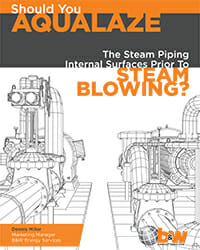
Steam Blowing
Professionally Engineered Steam Blow Services
From new construction to MRO events, steam blowing plays an essential role in protecting the longevity of your facility’s steam systems and other critical equipment. Since our founding, B&W Energy Services has engineered and executed more than 170 steam blow projects in more than 20 countries for clients like Shell, ExxonMobil, Dow, Fluor, Zachry and more.
Whether you’re a combined-cycle power plant, LNG terminal, refinery, chemical plant or university, our team is committed to delivering expert engineering and thorough cleans for your facility’s systems.



Quick Facts
Service Type: High-energy thermal cleaning
Primary Purpose: Remove stubborn internal debris from steam systems
Typical Use Case: Pre-commissioning of steam lines and turbines
Core Method: High-velocity steam discharge
Operating Medium: Steam
Typical Velocity: Exceeds operating flow velocity
Operating Temperature: Up to system design limits
Pipe Range: 2″–120″+ diameter
Contaminants Removed: Weld slag, mill scale, rust, debris
Environmental Impact: Water-based, no chemicals
What Are Steam Blowing Services?
Steam blowing services use the flow of low-pressure, high-velocity steam to expand and contract the walls of piping systems. This process removes mill scale, weld slag, construction debris and other impurities from facilities’ piping systems prior to startup or during maintenance cleaning. Steam blows can also be combined with AquaLazing services to enhance the cleaning ability of steam blowing and shorten the duration of the steam blowing process.
B&W performs three main kinds of steam blowing services:
Continuous Steam Blowing
- The industry’s most common steam blow system method
- Shortest overall steam blow duration
- Constant disturbance factor
- Continuous high velocities throughout your facility’s piping systems
- Low reaction forces
- Minimal support or restraint requirements
Exhaustive Steam Blowing
- Longest overall steam blow duration
- Features a cyclical depressurization of your facility’s piping systems
- Intermittent disturbance factor
- High reaction forces
- Maximum support or restraint requirements
Hybrid Steam Blowing
- Mix of steady-state and cyclical conditions
- Features medium to long overall steam blow duration
- Intermittent disturbance factor
- Reaction forces vary
- Maximum support or restraint requirements
The B&W Steam Blow Services Difference
- We have one of the largest inventories of wet and dry steam silencers in the industry, allowing us to perform steam blows on facilities of all sizes, including some of the largest projects in the world
- Our dry steam silencers are designed to vent up to 900,000 lb/hr of steam while maintaining a 85 dB (or less) noise rating at 50 feet
- Our expert engineers design our own pneumatic high-strength target inserters to significantly reduce downtime during the steam blowing process
- All of our temporary pipe spools are fabricated to ASME standards and our prefabricated temporary vent piping systems are built to ASME B31.3 code
- Our team conducts 100% flow modeling and analysis of your facility’s steam system
- We minimize water usage by performing Zero Liquid Discharge steam blowing
How B&W Performs Steam Blows
Steam blowing services are a bit more complex than simply blowing steam. B&W creates and delivers customized steam blowing programs through our meticulous five-step process.
1. Assess
2. Model
3. Mobilize
4. Execute
5. Repeat
For engineering and execution that can meet even the most strict steam blow criteria, reach out to our team to see how B&W can deliver for both your pre-commissioning and maintenance cleaning needs.
Which cleaning method is best for my piping system: steam blowing, air blowing or pigging?
| Criteria | Steam Blowing | Air Blowing | Pigging |
|---|---|---|---|
| Primary Purpose | Clear debris with steam expansion | Clear water & light debris | Scrape/physically remove contaminants |
| Best for | Large pipeline systems, pressure tech | Smaller/multiple line systems | Long straight sections needing mechanical cleaning |
| System condition | Wet, after hydrotesting | Wet, after hydrotesting | Dry or semi-dry lines |
| Typical contaminants | Debris, welding scale | Water, sand | Debris stuck to piping |
| Equipment | Steam blow hardware + silencers | Compressors + blow lines | Pigs + launchers/receivers |
| When to choose | When steam system validation matters | When air & water need removal quickly | When mechanical contact with pipe wall is needed |
FAQs
What equipment is needed for effective steam blowing?
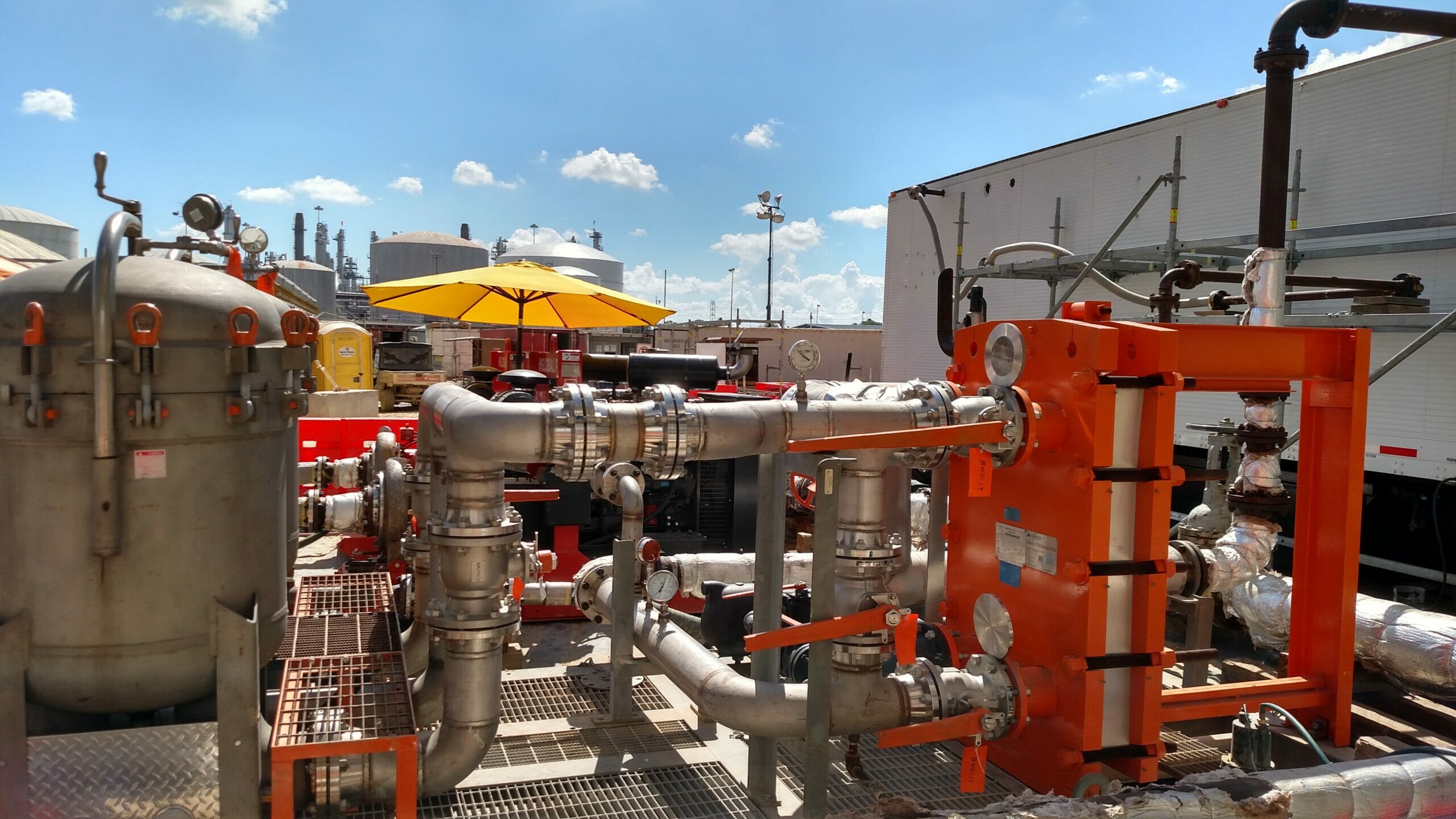
Effective steam blowing requires specialized equipment, including high-capacity silencers for noise control, quick-opening steam blow valves, pneumatic target inserters, target plates for cleanliness verification, temporary piping fabricated to ASME B31.3 standards and sacrificial valves to protect permanent equipment.
Steam silencers are critical. Wet silencers use quench water to reduce steam temperature and noise, while advanced dry silencers can handle up to 900,000 pounds per hour of steam at 85 dB without requiring water.
B&W Energy Services maintains one of the largest inventories of both wet and dry silencers in the industry, allowing us to set up 10 or more silencers simultaneously on large projects. Our proprietary pneumatic target inserters enable safe, efficient deployment and retrieval of target plates during blowing operations.
All temporary pipe spools are fabricated with ANSI B16.5 flanges to eliminate leak risks. We also use AFT Arrow hydraulic modeling software during engineering to ensure equipment is properly sized for your specific system requirements and OEM specifications.
Why is steam blowing better than other cleaning methods for steam piping?
Steam blowing is specifically designed for steam piping systems because it’s the only method that effectively removes tightly adhered mill scale and weld slag from high-pressure, high-temperature piping while simulating actual operating conditions.
Chemical cleaning can’t break the hard, bonded mill scale typical in new steam piping loose. Mechanical cleaning methods, like pigging, cannot navigate the complex configurations, multiple elbows, vertical runs and branched networks common in steam systems. Air blowing lacks the energy to remove stubborn deposits from steam piping. Steam blowing works because high-velocity steam combined with thermal cycling creates the “shock” forces necessary to fracture mill scale bonds and propel debris through the system.
The disturbance factor approach ensures cleaning occurs under conditions exceeding normal operation, guaranteeing startup readiness. For non-steam systems, like fuel gas, instrument air or process piping, B&W Energy Services recommends alternative methods like air blowing or AquaLazing. However, for steam generation equipment—boilers, HRSGs, superheaters and steam piping—steam blowing remains the industry standard because it’s the only method that consistently achieves OEM cleanliness requirements.
What safety precautions are necessary during steam blowing?
Modern steam blowing incorporates extensive safety precautions developed over decades to protect personnel and equipment. B&W Energy Services’ procedures address all major hazards, including high-energy steam releases, noise exposure, thermal hazards and pressure-related risks:
- Silencer technology reduces noise from historically dangerous levels above 140 dB to 85 dB or less
- Personnel exclusion zones are established around discharge areas during steam blowing operations
- Comprehensive engineering procedures calculate reaction forces and verify adequate pipe supports and restraints before operations begin
- Quick-opening valves are remotely operated to keep personnel clear of equipment during releases
- All temporary piping is fabricated to code standards with proper pressure ratings and safety factors
- Phased pressurization verifies system integrity before full-pressure blows begin
- Lockout/tagout procedures protect against inadvertent equipment operation
- B&W’s field teams receive extensive training on steam blowing hazards and emergency response procedures
Our safety record demonstrates that properly engineered steam blowing executed by experienced contractors poses minimal risk when appropriate precautions are implemented and followed throughout the project.
How does combining AquaLazing with steam blowing reduce costs?
Combining AquaLazing with steam blowing reduces overall project costs by removing mill scale before steam blowing begins, significantly decreasing the number of steam blow cycles required to achieve cleanliness.
AquaLazing, B&W’s proprietary high-pressure water jetting technology operating at 15,000 psi, mechanically removes mill scale, construction debris and surface contamination from steam piping systems. When performed before steam blowing, AquaLazing gives the steam blowing program a head start, resulting in fewer steam blow cycles required to reach OEM acceptance criteria.
This reduces natural gas consumption for steam generation, decreases water use, shortens overall project duration and reduces wear on new boilers or gas turbines during commissioning. The combined approach also allows more efficient equipment rotation on large projects with multiple systems.
B&W Energy Services pioneered this integrated cleaning methodology, and it has now become best practice on major power plant and refinery projects worldwide. The cost savings from reduced steam blowing duration typically exceed the added expense of upfront AquaLazing. Additionally, starting equipment with cleaner systems reduces the risk of debris-related failures during critical early operational periods, avoiding expensive unplanned outages and warranty issues.